.gif)

June 9, 2026
Private Swaps: Trade Crypto Without A Trace
If you've ever traded on a DEX, you've almost certainly paid the transparency tax. Bots front-run pending transactions, sandwich attacks extract value before trades close, and most users never see it itemized anywhere - it's just value that silently disappears.
The same problem applies to OTC, just at a much bigger scale - with position sizes, timing, and counterparties all generally readable onchain. Let's break down some solutions.
How private swaps work today
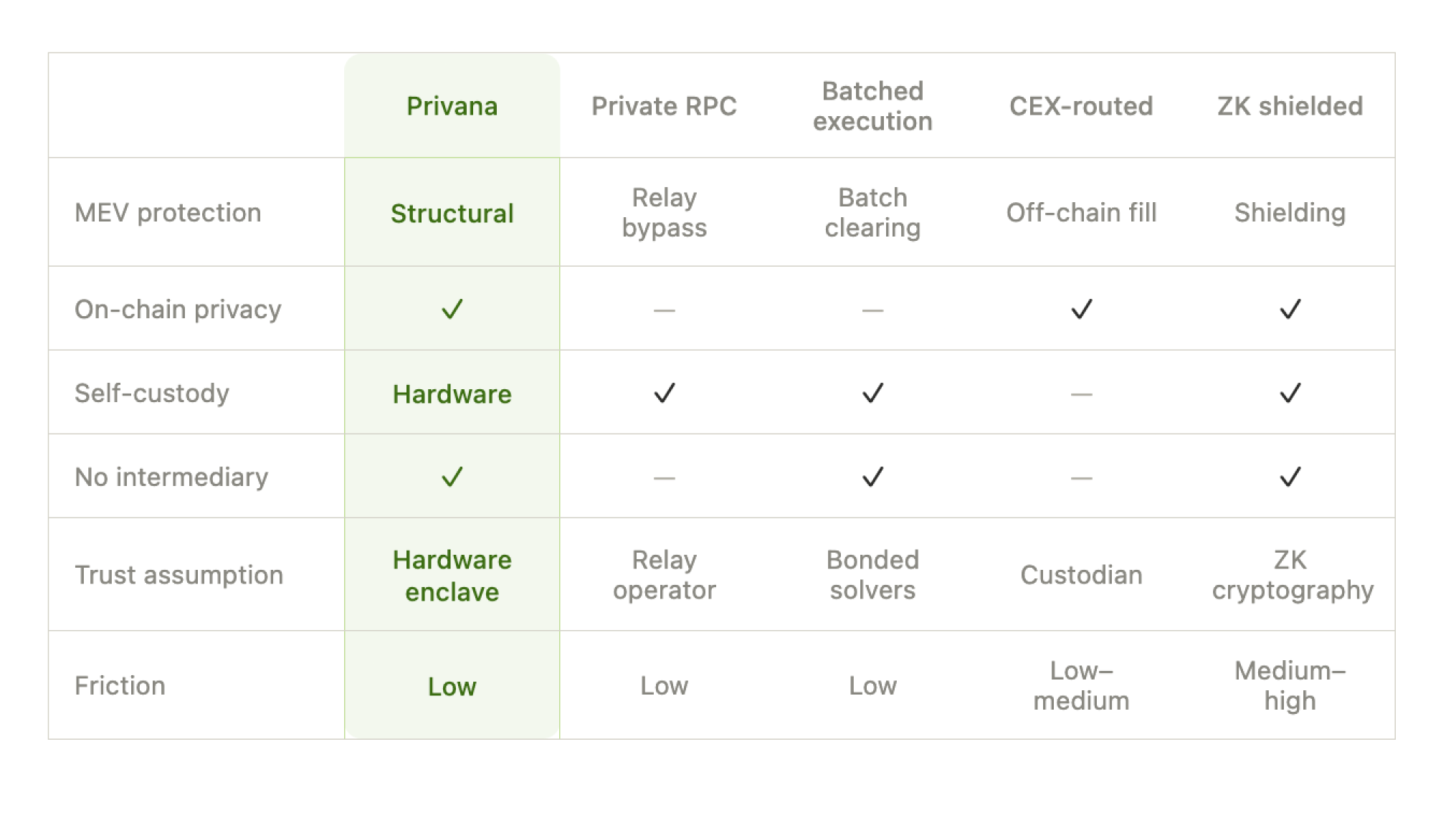
The public mempool is a feature of most blockchains: your intent is visible before it settles, and bots are always watching. There are solutions to this, but most move the problem rather than fundamentally solving it. At the bottom of it, every approach to private swaps is a decision about where to move the trust.
Relays and private RPCs move it to an operator. Your transaction bypasses the mempool but the relay sees everything. You've traded bot risk for some level of counterparty risk. Batched execution removes mempool exposure by not broadcasting until orders are already matched. Nothing to front-run. But your wallet activity is still onchain.
CEX-routed swaps break the onchain link between your wallets, but your assets pass through a third party to get there. The trust moves to a custodian. ZK shielded pools move the trust to cryptographic proofs. Balances and transaction details hide inside the pool. The tradeoff is friction and a constrained environment: assets shield in, interact privately, unshield out.
Encrypted mempools hide transaction intent until block inclusion, so there's nothing for bots to read before settlement. Still early in deployment, nowhere near a default for most users.
Overall, the pattern is consistent. Each trades one trust assumption for another. What's missing is an approach that doesn't require trusting an operator, a custodian, or a counterparty at all.
What private swaps give you
The clearest benefit is no MEV exposure. Your swap intent is never in the public mempool, so bots have nothing to front-run or sandwich. You get the price you see.
Beyond that, private swaps mean your onchain activity isn't readable by analytics tools, other traders, or anyone watching the chain. Position sizes, timing, and trading patterns stay off the public record. For anyone who trades with any regularity, that's not a minor thing, because your wallet history is a map of everything you've done and everything you hold.
Who needs private swaps
Active traders are the obvious case. Every onchain transaction is a signal. Competitors and bots analyze wallet patterns to exploit or copy positions. Trading without broadcasting intent isn't a luxury; for anyone moving size, it's a basic operational requirement.
Large holders face a different version of the same problem. Once a wallet is publicly associated with significant holdings, it becomes a target: phishing, social engineering, and targeted attacks follow wallet activity. Private swaps and transfers reduce that surface area.
Project treasuries and institutional desks have both problems at once. Rebalancing, token buybacks, and large OTC settlements all leak strategy on public infrastructure. TradFi solved this with dark pools. Crypto hasn't had a clean equivalent.
Private Swaps With Privana
Built with Oasis infra, Privana is a trading app enabled through key encumbrance, a cryptographic primitive where a private key is generated inside a TEE enclave on Oasis and never leaves it. You don't hold the key directly. Instead, you define policies (spending limits, token restrictions, time windows) and the enclave signs transactions that meet those conditions. The key never moves. The signature is the only thing that comes out.
When you swap, your intent passes through that policy engine inside the enclave and is signed and submitted before it ever touches public infrastructure. There's no mempool exposure because the transaction originates from inside the hardware, not from a wallet broadcasting to the network. And because all users share the same vault, there's no way to tell from onchain data which user initiated what or how much they moved.
The rivacy is structural, not a relay layer added on after the fact.
Private swaps on Privana will be live at launch alongside passive yield, all running on the same enclave infrastructure
.gif)