.gif)

June 1, 2026
Comparing DeFi Privacy Solutions

DeFi is growing up. The neobanking layer is taking shape, with protocols powering consumer products that never surface a blockchain to the user. Institutions that spent years on the sidelines are starting to route real capital onchain. Stablecoin supply is steadily up and to the right. And previously hostile regulators have bluntly signaled the green light to move finance onchain.
These are all notable developments, but the maturation of DeFi also exposes things that didn't matter as much when there were fewer users and less capital at stake. Security remains a big one. On-ramp and general UX friction is (still) another. And sitting underneath both of them is a structural problem that's long overdue for a solution: privacy.
MEV and the Cost of Public Transaction Ordering
In 2026, most trades on a public blockchain are transparent unless the user is taking active steps to avoid it. The cost of this transparency shows up primarily as MEV, maximal extractable value. Block producers have full discretion over transaction ordering. Searchers run bots that scan pending transactions and act in the window between submission and confirmation.
The most common mechanic is a sandwich: a bot sees your pending swap, buys the same asset ahead of you, waits for your transaction to execute at a worse price, then sells immediately after. Researchers have documented tens of millions extracted this way. The total numbers are likely much higher. What makes MEV hard to reason about is that it is not only extractive. The same infrastructure that lets bots front-run users can also be used to intercept exploits, rescue funds mid-attack, or close arbitrage gaps.
Bad MEV taxes users silently. Good MEV can stabilize protocols and hinder attackers during live exploits. The underlying question is not whether MEV is good or bad per se but who controls transaction ordering, under what rules, and where the extracted value goes. Different solutions are trying different answers to that question. In particular to ‘bad’ MEV, here are a few.
DeFi Privacy Tools Compared
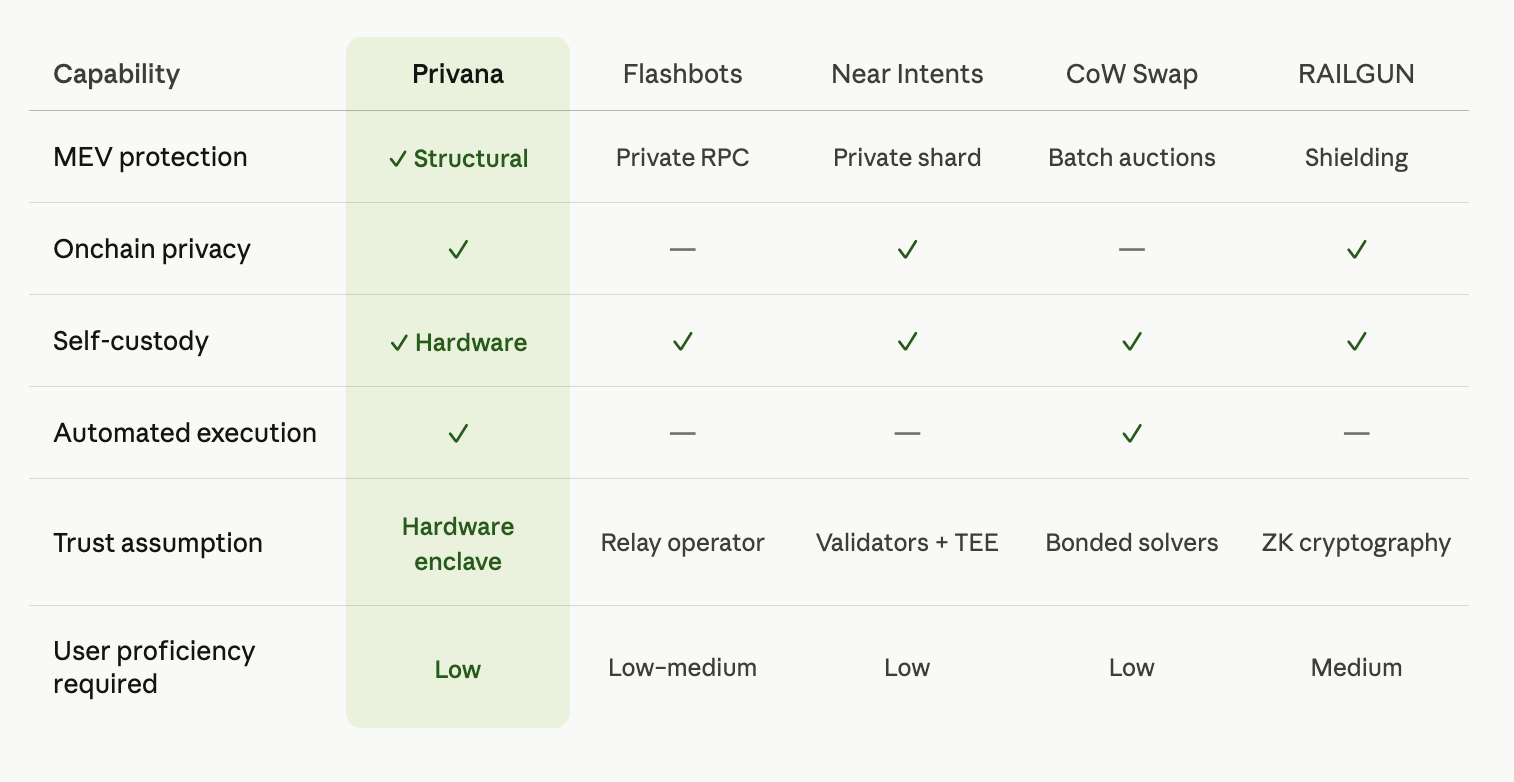
Lack of onchain privacy is a highly discussed problem and there are now quite a few solutions, each approaching from a different angle and methodology.
Flashbots / private RPCs
Flashbots operates a private RPC endpoint that sends transactions through a private path rather than broadcasting them to the public mempool, reducing the opportunistic attack surfaces. It changes the path a wallet uses to send transactions, not the wallet itself. This has been used to protect billions of dollars of transactions on Ethereum, although it requires manual opt-in.
- Transaction routed directly to block builders, never entering the public mempool
- The relay operator retains some visibility; trust is transferred, not fully eliminated
Near Intents
Near Intents is a multichain protocol where users specify a desired outcome and a network of solvers competes to fulfill it. Intents has a confidentiality option, which routes transactions through a private shard operated by a decentralized set of validators via a TEE-based bridge, keeping token pairs, order sizes, and timing out of the public mempool.
- Transaction details remain private and only become visible on the public chain after execution
- Confidential mode is opt-in; standard intents still broadcast to solvers without privacy guarantees
CoW Swap
Users sign an intent to trade rather than a raw transaction. A network of bonded solvers competes to find the best execution path across onchain liquidity, private market maker inventory, and peer-to-peer matching. When two traders want opposite sides of the same trade, CoW settles them directly with no mempool exposure.
- Can be more efficient than standard DEX pricing routes via solver competition
- MEV protection comes from delegated execution, not cryptographic enforcement
Railgun
Uses zk-SNARKs to shield token balances and transaction history inside an onchain privacy pool. Shielded assets sit in encrypted smart contracts deployed directly on various chains, no separate network or bridge required. From the outside, activity is not traceable to the user; only a broadcaster wallet address is visible onchain.
- Comprehensive at the asset level: supports ERC-20s, NFTs, and private DeFi interactions
- Shielding and un-shielding mechanics add steps that require some proficiency bar for users
Privana
Builds privacy directly into the execution layer using a trusted execution environment on Oasis. With Privana, swap intents are signed inside a hardware enclave before they reach any public infrastructure. The private key never leaves the enclave, not accessible to external observers, not to Oasis, not to Privana.
- The same enclave handling interactions also holds the vault key, meaning automation, yield routing, and rule-based execution all run privately without the user present
- No relay to trust, no shielding step to manage; custody stays with the user throughout
The Future of Private DeFi
These approaches sit on a spectrum from mempool-level workarounds to cryptographic enforcement to hardware-sealed execution. The best tool to use depends on who you are and what your goals are.
What they share is a common premise: public transaction ordering is adversarial by default and worth solving. Where they differ is what types of guarantees they offer and how much they ask of the user to get there.
The next generation of privacy solutions in DeFi will mostly not ask users to think about any of this. Some will be white-labeled into neobanking products and wallets, running underneath interfaces that look nothing like DeFi. Some will be agent-native, handling execution on behalf of users who set rules once and step away.
Alongside better UX and security, privacy is a core requirement for the next leg of DeFi growth. The solutions built around these assumptions are the ones that will ultimately matter at scale. Privana was built around precisely this.
.gif)