

November 20, 2026
MEV, explained: why your swaps cost more than they should
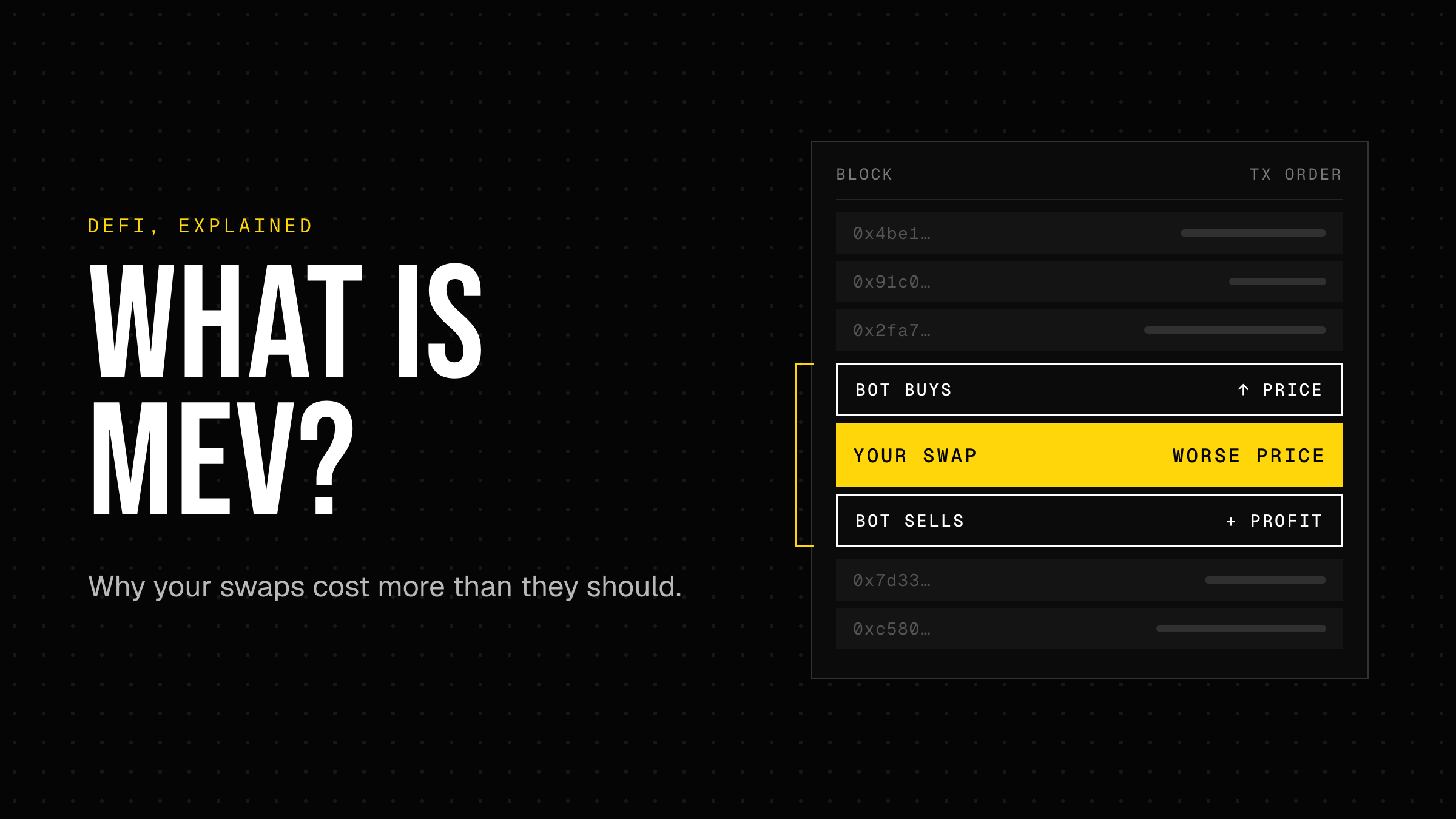
More than 12,000 wallets get sandwiched on Ethereum every week (DefiLlama Research). Most of those traders never notice. The attack doesn't look like an attack; it looks like a slightly worse price.
The cause is MEV. It's probably the most important and least understood part of how crypto actually works, and most people who've been in DeFi for a while have simply learned to accept it.
What is MEV?
MEV stands for maximal extractable value: the profit that can be made by reordering, inserting or excluding transactions within a block. Every time you swap tokens on a DEX, your transaction is briefly visible before it settles. In that window, bots can see what you're doing and act on it.
Two groups make this possible. Block producers collect transactions and build them into blocks. They decide the order, which means they see transactions before including them.
Searchers are the bots on the other side. They run onchain monitoring tools to find and act on MEV opportunities. A failed attempt only costs a gas fee, so trying at high volume makes sense whenever the potential payoff is large enough.
How it works
The most common version is the sandwich attack. A bot sees your swap and buys the token just before you, pushing the price up. Your trade then executes at the worse price, and the bot sells straight after. You get less than you expected, and the bot keeps the difference.
Frontrunning is simpler. A bot spots your pending transaction, copies it and submits the same trade with a higher gas fee to jump ahead in the queue. Backrunning means placing a transaction right after a large trade to capture the arbitrage it creates.
On Ethereum alone, there were 60,000 to 90,000 sandwich attacks a month between November 2024 and October 2025 (Cointelegraph Research, using EigenPhi data). It has become background noise, the kind of thing people shrug at because that's just how it is.
It's not all bad
MEV is a problem, but calling it purely predatory oversimplifies it. The same bots that tax users also keep DeFi working. Lending protocols like Aave rely on MEV incentives to get bots to liquidate bad debt, which is what stops them from going insolvent.
Arbitrage bots constantly correct prices across DEXs, which is why a token costs roughly the same on Uniswap and Curve at any given moment. Without that activity, prices would drift and liquidity would fragment. It's load-bearing infrastructure, which is part of why it has lasted.
The bigger problem
That staying power has costs beyond individual swaps. Cheaper, faster chains have made the problem worse, not better: on low-fee networks, bots take up a large share of blockspace while paying a small share of the fees. Users who never touch a DEX still pay for this through higher base fees and congested blocks.
There's also an incentive to propose blocks as late as possible, because that captures more MEV. To make sure their blocks still propagate in time, proposers cluster geographically. MEV quietly pulls toward centralization inside systems designed to be distributed.
What people are doing about it
Fixes come from several angles. Flashbots moved the competition offchain, and a large share of Ethereum transactions now travel through private channels instead of the public mempool.
CoW Swap batches orders so there's no queue to front-run. 1inch runs Dutch auctions where market makers compete to give users better prices. Many wallets and RPC providers now let you switch on MEV protection with one click, and some pass rebates back to you.
At the protocol level, researchers are exploring encrypted mempools, execution inside secure hardware enclaves, and multi-proposer designs that would break the ordering monopoly entirely.
The catch is that most of this is still opt-in. You have to know MEV exists, know which tools to use and route your transactions through them. The average person clicking "swap" doesn't, and they pay for it. Protection needs to become the default.
Frequently asked questions
Do wallets like MetaMask, Phantom or Ledger already protect me from MEV?
Some do, partially. MetaMask routes swaps through smart transactions, bypassing the public mempool. Ledger Live and Trezor have MEV protection on Ethereum. Coverage varies by wallet and chain, so check your own wallet's settings rather than assume.
Two caveats: wallet-level protection usually only covers the chains that wallet prioritizes, and it shields individual trades from front-running without making your onchain history private.
What's the difference between MEV protection methods?
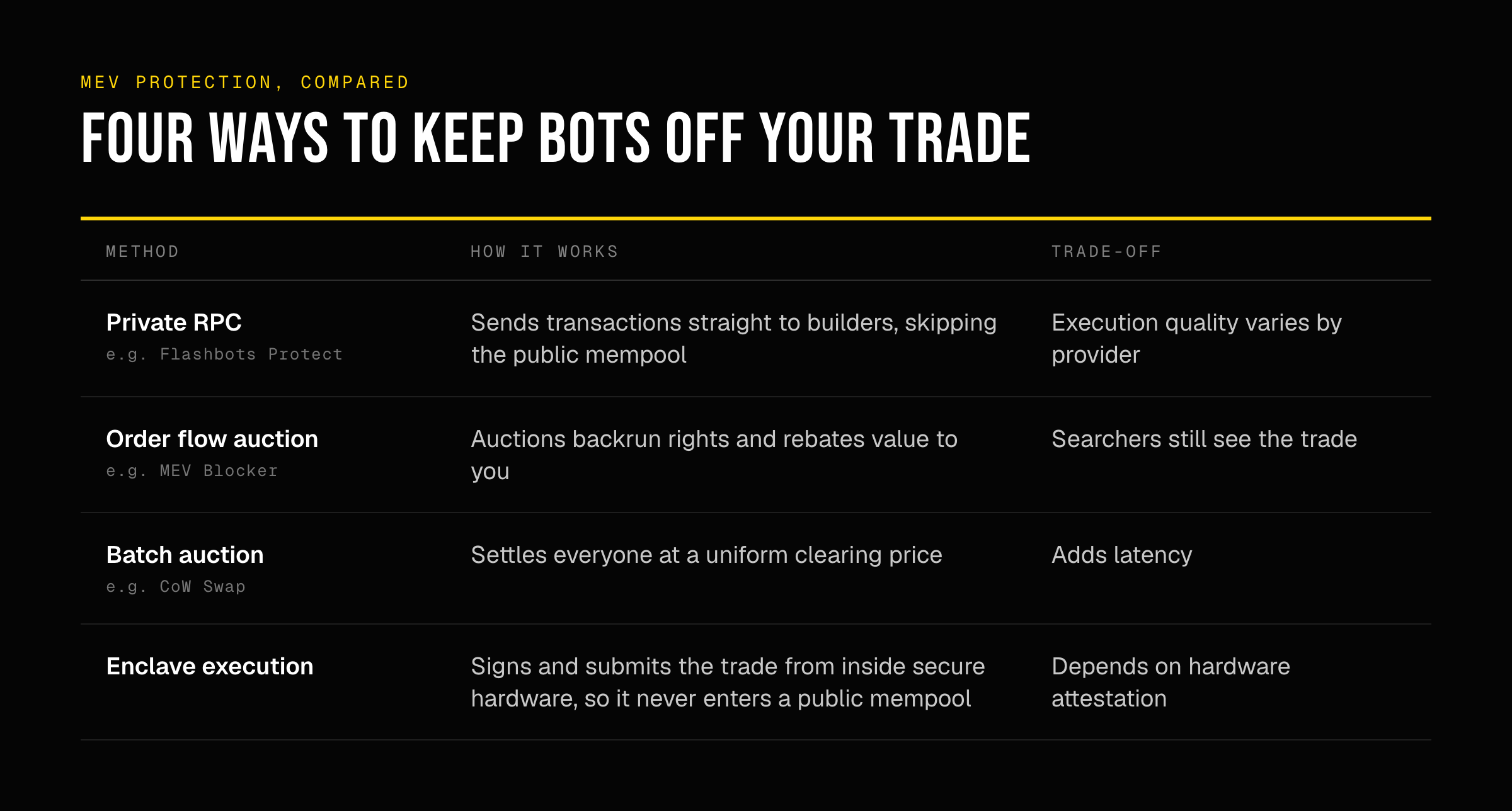
Around 80% of Ethereum DeFi flow now goes through private RPCs rather than the public mempool (CoW DAO benchmark, 2025). Most methods move the trade somewhere bots can't reach, then manage what leaks. Enclave execution aims to remove the exposure window altogether.
Should I turn MEV protection on or off?
On. It costs almost nothing and removes a real cost you'd otherwise pay without noticing. The only reason to turn it off is if you need the absolute minimum latency on a specific trade.
Execution quality differs across providers. The CoW DAO benchmark found MEV Blocker and Flashbots return 100% of backrun value to users, while some others return none. Two people with protection switched on can get different outcomes depending on which service their wallet uses.
Is MEV protection automatically on for some blockchains?
Not really. Polygon launched a private mempool that bypasses public visibility, but it activates through an RPC switch, so someone has to choose it. That's the general pattern: more chains offer protection every year, but it's almost always opt-in somewhere in the stack. Whether you're protected usually depends on your wallet or app, not the chain.
Which MEV protection approach works best?
There's no single winner. Compare four things:
- Coverage: every transaction, or only certain chains?
- Execution quality: the CoW DAO benchmark found real differences between providers.
- What still leaks: some methods share details with searchers in exchange for rebates.
- Whether you have to think about it: a casual swapper should weigh this one heavily, because the realistic failure is having no protection at all, not a slightly worse version of it.
How can I protect myself from MEV front-running?
- Check whether your wallet has MEV protection, and switch it on.
- Set a tighter slippage tolerance. Attacks only pay within the limits you allow.
- Break large trades into smaller ones.
- Use a protected RPC endpoint, or an interface that routes privately by default.
- Trade in deeper liquidity pools, where your order moves the price less.
What services provide MEV protection for decentralized exchanges?
- Flashbots: private mempool, configurable transaction visibility.
- MEV Blocker: order flow auction with value rebates.
- CoW Swap: batch auctions, no ordering advantage inside a batch.
- 1inch: Dutch auctions with competing market makers.
Most of these are infrastructure you route through, so you need to know they exist and set up your wallet to use them.
Is MEV actually a risk for regular traders, or just big accounts?
It reaches regular traders as a recurring cost. EigenPhi data shows around 1.2% of Ethereum DEX trades get sandwiched, with an average loss of 0.41% per trade. More than 12,000 wallets a week are hit on Ethereum alone.
Solana saw about 1.55 million sandwich attacks in 2025. Each one is small, but they add up. There's an indirect cost too: bot activity takes up blockspace and pushes up fees for everyone.
Is MEV protection worth it, or is the risk overstated?
Worth it. Sandwich attacks on Ethereum are well down from their peak: the share of blocks containing at least one fell from about two thirds in 2024 to about one fifth by mid-2026 (DefiLlama Research). But they still hit thousands of wallets every week.
Some MEV does useful work, like arbitrage keeping prices consistent across DEXs and liquidations protecting lending protocols. Protection still costs close to nothing: you give up a little latency and avoid an unpredictable cost that lands hardest on large trades in thin liquidity.
Sources and further reading
Paste at the end of the post, in place of "MEV Resources". The first three back the figures above; the rest are the reading list from the live post.
- DefiLlama Research: Sandwich attacks, private routing and what THORChain does differently
- Cointelegraph: Notorious sandwich attack bot jaredfromsubway.eth exploited for $75M (EigenPhi data)
- Flashbots: When frontrunning is alchemy
- Paradigm: Ethereum is a Dark Forest
- Flashbots: Frontrunning the MEV Crisis
- Quantifying Blockchain Extractable Value
- Paradigm: The Key Neutrality of Baselayer Markets
- Extropy: State of MEV Research 2025
- Extropy: Cross-Chain MEV Analysis
The CoW DAO benchmark and the Solana figures are cited in the text but have no link. Add their sources before publishing, or cut those lines.
